Bees and Bears: a sloth bear, a bee, and a flowering Mahua branch, encircled in gold

Somewhere in Central India · Coming 2028

Bees & Bears

A Forest Atelier

A place where people, ideas and landscapes not only coexist, but create and grow together.

Our values

Our four guiding principles.

Ecological honesty

We build within the logic of the land: the slope, the drainage, the rhythms of the Mahua are guides to follow, not obstacles to overcome.

Rooted in Place

Materials, food, labour, stories and knowledge come from the landscape around us wherever possible.

Coexistence as Practice

The forest is not a backdrop. Conservation is a way of living within ecological limits, not an activity separate from life.

Shared Stewardship

Contribution takes many forms: patronage, knowledge, creativity, labour, or care. Meaningful places endure when shared.

Before we begin

Help us build this right.

Before we open Bees & Bears, we want to understand what actually matters to people who travel for nature, and what consistently lets them down at Indian resorts and jungle stays.

This is not a marketing survey. The answers will directly shape what we offer, how we price it, and what we refuse to compromise on. We will publicly share a summary of what we learn. It takes 8–10 minutes; no personal data is collected unless you choose to leave your email.

Help us build this right, and we'll remember you when the doors open.
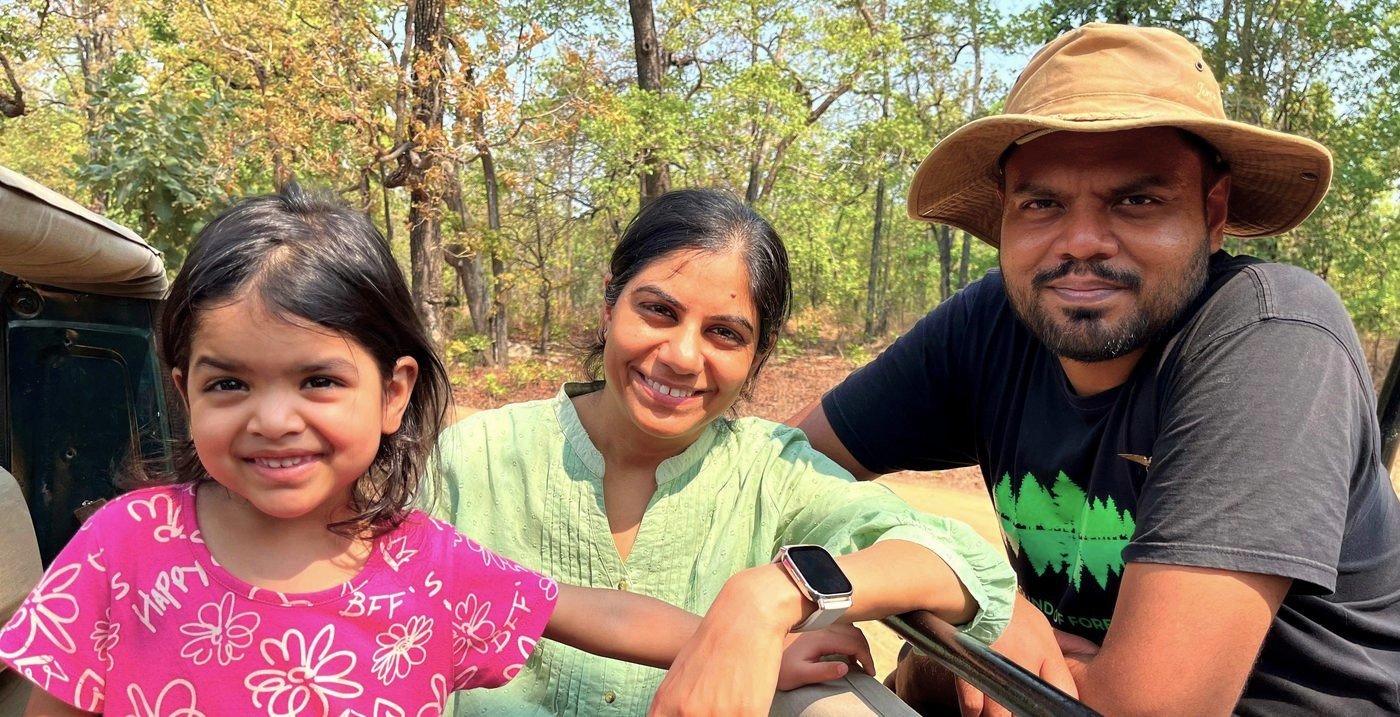
Debadityo, Parul and their daughter Teekshita together on a forest safari in Central India
Debadityo, Parul and Teekshita, somewhere in the forests that shaped this idea.

Curious why we are building Bees & Bears, who we are, and what we hope this place becomes?

Read Our Full Story

The inner circle

Be the first to know where we are.

We are two years from opening. In that time we will be building walls, watching wildlife, writing essays, and making difficult decisions about how to do this right. This community is where we share what we find.

Dispatches

Occasional emails from the build, only when something happens worth writing about.

First access

When we open bookings, community members hear first, before anyone else.

The reveal

When we are ready to share where we are, you will be the first to know.

The full story

Our Story

Why we are building Bees & Bears, who we are, and what we hope this place becomes.

← Back to Home

The Seed

We live in a time of climate uncertainty, biodiversity loss, and a rapidly changing relationship between people and nature. At the same time, many of the places where we once came together to learn, reflect, debate and imagine better futures are becoming increasingly fragmented, specialised or transactional.

Our institutions often reward expertise over curiosity, outcomes over observation, and deliverables over values. Conversations about nature are increasingly shaped by headlines, funding cycles and urgency. But some questions cannot be answered quickly. They need time, attention and a willingness to sit with complexity.

How do people and wildlife continue to share landscapes? What can traditional knowledge teach us about living within ecological limits? And how can we understand a place deeply before deciding what needs to change?

We felt that something was missing.

We need places that are slower, smaller and more grounded. Places where different kinds of knowledge can meet, where difficult questions can be explored without easy answers, and where people can spend enough time in a landscape to really notice it.

Places where we can listen before we prescribe, observe before we intervene, and learn before we try to change.

Places where coexistence is not merely discussed, but practised.

The People

Bees & Bears began with a conversation between Debadityo and Parul, a conservationist couple who have spent much of their lives defending nature together, in the field and in the courtroom.

For more than fifteen years, Debadityo has worked to protect the forests and wildlife of the Vindhyas. He founded Vindhya Bachao in 2010 and Vindhyan Ecology & Natural History Foundation in the year 2012, and has spent years working alongside communities, researchers and conservationists to defend the landscape and its sloth bears. His work earned him the title "Bear Keeper of Mirzapur" from GQ India in 2020 and the Sanctuary Wildlife Service Award in 2019, among other recognitions.

He has also spent nearly two decades working on environmental policy and law, first with a leading environmental advocacy organisation and later at a leading public policy think tank in Delhi, working on forests, wildlife and environmental governance. After years of trying to protect the environment through institutions and policy, he increasingly felt the need to return to his roots, commit himself fully to the landscape he had spent so long working to protect, and explore what building a more sustainable future from the ground up could look like.

Parul has spent more than two decades defending nature in the courtroom. A lawyer practising exclusively in conservation litigation since 2009, she has represented conservationists and activists in challenges involving environmental and forest clearances for hydropower, thermal power, mining and other large development projects across the Himalayas, Northeast and Central India.

After years of seeing environmental conflicts unfold in court, Parul came to believe that many of them begin much earlier. They begin with an erosion of human values and a growing disconnect between people and the natural world.

Bees & Bears is where these two journeys meet.

But it is also shaped by something more personal. When their daughter, Teekshita, was born in 2022, questions about the future of nature took on a different meaning. They began to think more deeply about the world she would inherit, and about the kind of relationship with nature they wanted to pass on to her.

They realised that protecting forests also means creating spaces where people can learn to understand them, experience them and feel connected to them. Places where the next generation can ask questions, encounter different ways of knowing, and imagine a future in which people and nature do not have to exist at the expense of one another.

Bees & Bears grew from that realisation.

The Place

Some will come to explore. Some to study, create or teach. Some may simply come to slow down and observe.

We hope that everyone who spends time here leaves knowing the landscape a little better, asking a few more questions, and perhaps seeing their own place within the natural world a little differently.

On the Name

A place is defined by its landscape, its inhabitants and its stories. In our imagination, this place had two important inhabitants: one small enough to fit in the palm of a hand, the other large enough to leave unmistakable footprints on the forest floor.

Wild bees move through these forests present everywhere, claiming nothing. The sloth bear does something similar in its own way, carrying seeds across the landscape as it feeds. Neither performs for an audience.

A tiger sighting is an event; a bee on a flower or a bear turning over a log is simply another day in a healthy forest, one of the countless quiet tasks that keep it alive. It would have been easy to borrow the tiger's charisma for a name. We chose instead to honour the pollinator and the gardener, the small and the shy, the overlooked and the indispensable.

Before we begin

Help us build this right.

Take our short survey, or join the community to follow along as this place takes shape.

Take the Survey Join the Community